
.png)
gender affirming care


what is gender affirming care?
Gender affirming care refers to any type of physical, behavioral, or mental health care that supports and affirms a person's gender identity. You might notice that our definition doesn't specify that gender affirming care is just for transgender people; that's because it's not! Cisgender people get gender affirming care all of the time. People of all genders access hormone replacement therapy (HRT) to manage hormonal imbalances or treat medical conditions. Gender affirming surgeries are also common for cisgender people. Cisgender women who are dissatisfied with their chest may get breast implants, and some cisgender men with gynecomastia may get mastectomies. It's almost important to remember that not every transgender person medically transitions! Medical transition is NOT required to be transgender, and gender affirming care is for anyone who wants or needs it.
how to access gender affirming care
Accessing gender affirming care may be a challenge, depending on the type of gender affirming care you want to access, where you live, laws and policies in your area, your age, and your parent or guardian's approval. Knowing what is possible and what to expect can help the process of accessing care go as smoothly as possible.
Check out our find a provider page for resources to help you locate and vet providers of gender affirming mental health care. For gender affirming medical care, read on.
In the US, gender affirming care has been under attack, especially for people under 19. Movement Advancement Project tracks bans on best-practice medical care for transgender youth, as shown in the map below. Is your state impacted?
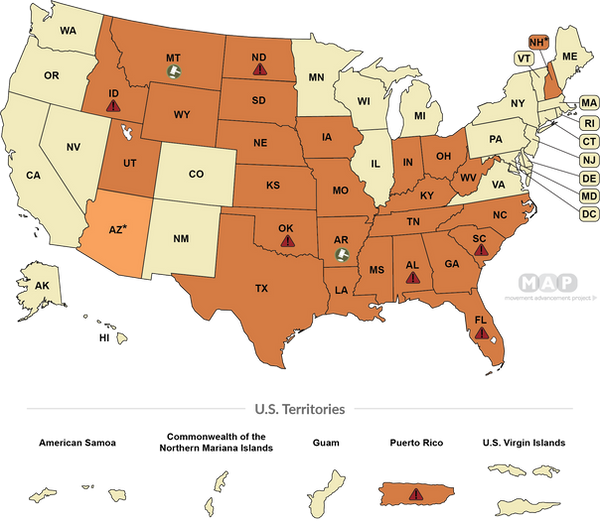
Go to MAP's website for a clickable version of the map with more detail about each the legal landscape of gender affirming care in each state.

Source: Movement Advancement Project. Updated as of April 2026.
When looking for a gender affirming medical care provider, find out...
-
Are they accepting new patients?
-
Do they accept patients of your age?
-
Do they accept your insurance?
-
Do they advertise as trans affirming, competent, etc.?
-
How much experience do they have working with trans folks?
-
How is the ease of access for you? (Location, hours, accessibility)
Some providers may offer this information online, but others may require you to call in advance to get answers to these questions. Prepare by taking notes on what you need to know before calling or going to your first appointment.
Depending on the provider, there are certain things they might require for you to access gender affirming hormone therapy or surgeries.
-
An age limit; some providers do not treat people under 18 (or 19)
-
A letter of support from a mental health care provider
-
The ability to make an informed decision and consent to treatment
-
Labs/blood work and possibly a physical exam prior to authorization to identify any conditions that might impact your health or gender affirming treatment
-
An in-depth conversation about your identity, goals for treatment, and mental and physical health history
-
A diagnosis of gender dysphoria from a health professional

click here for help finding a gender affirming care provider near you
puberty blockers
Puberty blockers are medications, usually gonadotropin-releasing hormone (GnRH) analogues, that temporarily stop the changes that would happen during puberty. They work by blocking the hormones that your body would produce normally; for people assigned female at birth, that's estrogen, and for people assigned male at birth, that's testosterone.
For young people who are figuring out their gender identity and think they might be transgender, puberty blockers can give them more time to figure out their identity and reduce the distress they might feel from the changes that happen during puberty. Starting puberty blockers before some of these changes take place can also reduce the need for some types of gender affirming care in the future, such as hair removal or mastectomies.
types of puberty blockers
the implant: a flexible rod called histrelin acetate that is inserted under the skin of the arm and works for up to 1 year.
the shot: an injection containing leuprolide acetate, which lasts for 1, 3, or 6 months.
when can I start puberty blockers?
You can start puberty blockers as soon as you start puberty, typically when you're between 9 and 12 years old. Someone can be on puberty blockers for Eventually, you'll need to decide if you want to either start hormone therapy or stop blockers. Puberty blockers are very safe and the effects are reversible. If you stop taking them, puberty will start again.
what are the effects of puberty blockers?
Puberty blockers stop your body from developing secondary sex characteristics that would otherwise develop during puberty. For people assigned female at birth, puberty blockers stop things like breast development and menstruation (aka a period). For people assigned male at birth, puberty blockers stop things like facial hair growth and voice deepening. To learn more about the changes that happen during puberty, click here!
feminizing hormone therapy
Feminizing hormone therapy is used by transgender people who want their body to develop secondary sex characteristics that are typically perceived as more feminine. Usually, this type of hormone therapy is accessed by transgender women and nonbinary transfeminine people.
Feminizing gender affirming hormone therapy replaces and/or suppresses the hormones that your body would produce without this intervention.
types of feminizing HRT
estrogen: primary hormone used in HRT that results in physical and emotional changes.
anti-androgen medications: blocks the production of testosterone; spironolactone is most commonly used. Used alongside estrogen.
ways to take feminizing hrt
-
pills
-
patches
-
injections
-
gels
-
sprays
_edited.png)

possible effects of feminizing HRT
-
Skin softens and becomes more sensitive
-
Body hair decreases
-
Breast tissue and nipples may become more sensitive
-
Breasts may gain a cup size or more.
-
You may experience a decreased sex drive
-
Penis and testes may atrophy (shrink)
-
You may be unable to get or maintain an erection
-
Ejaculation typically decreases and sometimes goes away completely within the first few months.
For more about how experiences with sex and relationships might change throughout transition, click here.

Want a downloadable info guide with all of the information you need to know about feminizing HRT? Click here!
masculinizing hormone therapy
Masculinizing hormone therapy is used by transgender people who want their body to develop secondary sex characteristics that are typically perceived as more masculine. Usually, this type of hormone therapy is accessed by transgender men and nonbinary transmasculinine people. Masculinizing gender affirming hormone therapy replaces and/or suppresses the hormones that your body would produce without this intervention.
testosterone is the primary hormone used in masculinizing gender affirming hormone therapy that results in physical, emotional, sexual, and reproductive changes.
ways to take testosterone
-
injections
-
gel
-
patches
-
pellets
-
pills
possible effects of masculinizing HRT
-
Skin becomes rougher and more oily and hairy, especially around the face
-
Body hair increases
-
Muscle mass increases and is easier to build
-
Voice deepens
-
The clitoris may noticeably increase in size
-
Increase in sex drive
-
The vagina can become more delicate and less self-lubricating
-
You may experience emotional changes like being happier or angrier, and you may respond differently to emotions; for example, crying less
For more about how experiences with sex and relationships might change throughout transition, click here.


Want a downloadable info guide with all of the information you need to know about masculinizing HRT? Click here!
what to expect
Make sure you are prepared for your first appointment with a hormone therapy provider! It’s incredibly important to be honest and up front with your doctor. Even though it might feel awkward to talk about some aspects of transition, they are there to help.
-
Make a note of the questions you want to ask so you don’t forget anything.
-
Consider bringing a supportive person who can take notes for you or advocate for you if necessary.
-
Your doctor may require a full physical; this could include assessing parts of your body that could make you feel dysphoric. Prepare yourself beforehand.
-
You will likely not be prescribed hormones at your first visit.
-
Your doctor will order blood work for you to complete, and will likely require a second visit to go over the results and finalize your treatment plan.
-
You will likely have an in-depth conversation about your identity and goals for treatment during your first appointment. Prepare to be asked about...
-
Your full medical history, possibly including family history
-
Any previous gender affirming care
-
Any endocrine (hormonal) disorders or history; thyroid, diabetes, etc.
-
Your gender identity, including your name, pronouns, etc.
-
How long you have been “out” or living as your true gender
-
Your transition goals
-
Why you want to start gender affirming hormone therapy
What changes you want from gender affirming hormone therapy
Any changes or effects you do not want or hope to minimize
-
After your first appointment...
-
During a follow up visit before starting HRT, your doctor should make sure that you know how to use whatever method of HRT you have decided on. For example, demonstrating how to do an injection on yourself; where to apply patches; how to avoid transferring to others if you are using gels.
-
Your doctor will most likely want to see you back for check ups and blood work every 3 months during your first year on HRT.
-
If you experience any side effects, contact your doctor right away. Side effects don’t mean you won’t be able to transition! You may just need a medication change.
-
Your dose will likely be increased (if that is what you want) over your first year on HRT. Do NOT increase your dose without consulting with your doctor.
vocal congruence
Vocal congruence is when a person’s voice is in alignment with their sense of self and accurately reflects who they are. Anyone can use resources to help their voice align more closely with who they are, not just transgender people!
aspects of voice
-
pitch: how high or low your voice sounds
-
resonance: the quality of the sound of your voice
-
weight: "lightness" or "heaviness"; controlling the bass in your voice
-
intonation: the rise and fall of pitch in your speech
anatomy of voice
Lots of parts of our body impact how our voice sounds, along with factors like where we grew up and our cultures.
-
Vocal cords/folds
-
Larynx/voice box
-
Muscles of your mouth and throat, like your lips and tongue
-
Your lungs and diaphragm
vocal congruence options
Self teaching
-
Using online resources such as those collected here or among other online communities like Reddit or Youtube can help some people change some of the aspects of their voice.
-
Changing your voice by yourself requires time, dedication, and motivation; but this method is the most cost effective!
Voice training
-
Voice training with a professional like a speech language pathologist (SLP) can help you better understand and adjust aspects of your voice to feel like your authentic self.
-
A great option for singers!
-
Voice training may be expensive, depending on your insurance and the provider you choose.
_edited.png)
Does vocal congruence sound like something you want to try?
-
Download our vocal congruence guide.
-
To start learning on your own, check out our vocal congruence YouTube playlist.
-
Want to try out voice training from experienced professionals (who are trans themselves)? Check out Undead Voice for free guides to vocal congruence and a free three week introductory voice training course!
Gender affirming voice surgery
-
These surgeries can raise the pitch of your voice by permanently changing the anatomy of your vocal cords.
-
This treatment option is more invasive and costly than others, and still only impacts pitch.
Hormone therapy
-
For people who take testosterone as part of their gender affirming care, they may see their voice deepen; as their vocal cords get bigger, their pitch range can move lower.
-
Testosterone only impacts the pitch of your voice, not other aspects that you may wish to change.
-
Estrogen taken by people who have already undergone puberty will have no impact on your voice.
_edited.png)
_edited.png)
gender affirming surgeries
Gender affirming surgeries (GAS) can help someone's body better align with their identity and reduce dysphoria. Just like with other types of gender affirming care, not all transgender people will access gender affirming surgery, and most who do are adults over the age of 18. Minors are less likely to access GAS because of insurance coverage and the cost of surgical care, local laws banning GAS for minors, issues with parental consent, and the body's ongoing physical development. When minors do access GAS, they are almost always getting top surgery, or mastectomies, to remove chest tissue. About 97% of gender affirming surgeries performed on minors are mastectomies, and these surgeries are rarely conducted before age 16.
Surgery is a big deal, even if it's for something that you want, and there are always risks involved, especially because you have to go under anesthesia for surgery. Any surgery will require significant recovery time, and usually cost a lot of money. Still, gender affirming surgeries have an extremely high satisfaction rate; research continues to show that transgender people are satisfied with their surgical care about 99% of the time!
Click through the tabs below to learn about the different types of gender affirming surgeries.
Top surgery refers to gender affirming surgeries that either remove or augment chest/breast tissue.
Masculinizing top surgery,
aka mastectomy
A surgery that removes breast tissue and reshapes the chest to appear more masculine. There are several kinds of procedures that have different results:
-
Double incision
-
Keyhole
-
Buttonhole
-
Inverted-T
-
and more!
The type of top surgery you can get mostly depends on how much chest tissue you have and your skin elasticity. The type of surgery you get will determine where the incisions are made to remove the chest tissue, resulting in different scar appearances. You can also choose to have a nipple graft, where your nipples and areolas are reshaped and resized, or remove your nipples entirely. Some people choose to have 3D tattooing after their top surgery to create the appearance of realistic nipples on their chest.
Feminizing top surgery,
aka breast augmentation
A surgery that adds implants under existing breast tissue to increase projection and make the chest appear more feminine.
For feminizing top surgeries, you will decide with your surgeon:
-
size of the implant - depends on your current and desired breast size
-
implant material - silicone, saline, or fat grafts
-
incision placement - under the nipple, under the breast, or under the armpit
To learn more about feminizing top surgeries and see photos of results, check out mtfsurgery.net.
To learn more about masculinizing top surgeries and see photos of results, check out topsurgery.net.